Upload your CSV
Drop in a table where each row is a respondent — a participant, a patient, a student — and each variable is a number describing them. If your data lives in SPSS, Qualtrics or Excel, a CSV export is all you need.
Discover the typologies in your respondents — no code, no statistics expert. Upload a CSV from your questionnaires, scales, assessments or other structured measurements and read the structure of your data in minutes.
Try Arkhety freeIf your research in psychology, education or behavioral sciences relies on questionnaires, scales, assessments or other structured measurements, your respondents fall into distinct profiles waiting to be revealed.
Discover distinctive response profiles in personality scales, attitudinal questionnaires and psychological assessments.
Identify student or participant typologies based on performance, motivation, habits or self-reported behaviors.
Find patient or respondent typologies from quality-of-life questionnaires, symptom inventories or wellbeing scales.
Built for research-sized datasets — a few hundred respondents are enough to find clear profiles. No big data, no programming, no waiting for the statistics expert in your department.
Drop in a table where each row is a respondent — a participant, a patient, a student — and each variable is a number describing them. If your data lives in SPSS, Qualtrics or Excel, a CSV export is all you need.
Arkhety finds the handful of distinctive typologies your data revolves around — the sharpest, most defined cases, not blurry averages. No labels, no presets, no domain assumptions.
Each profile comes with the variables that define it. Read your data at a glance — and see how every respondent blends between profiles.
Three archetypes from a well-being study, 300 participants. Lite gives you the summary — name, description and standout variables. Plus adds deeper charts, comparisons, an interactive map and a PDF report.
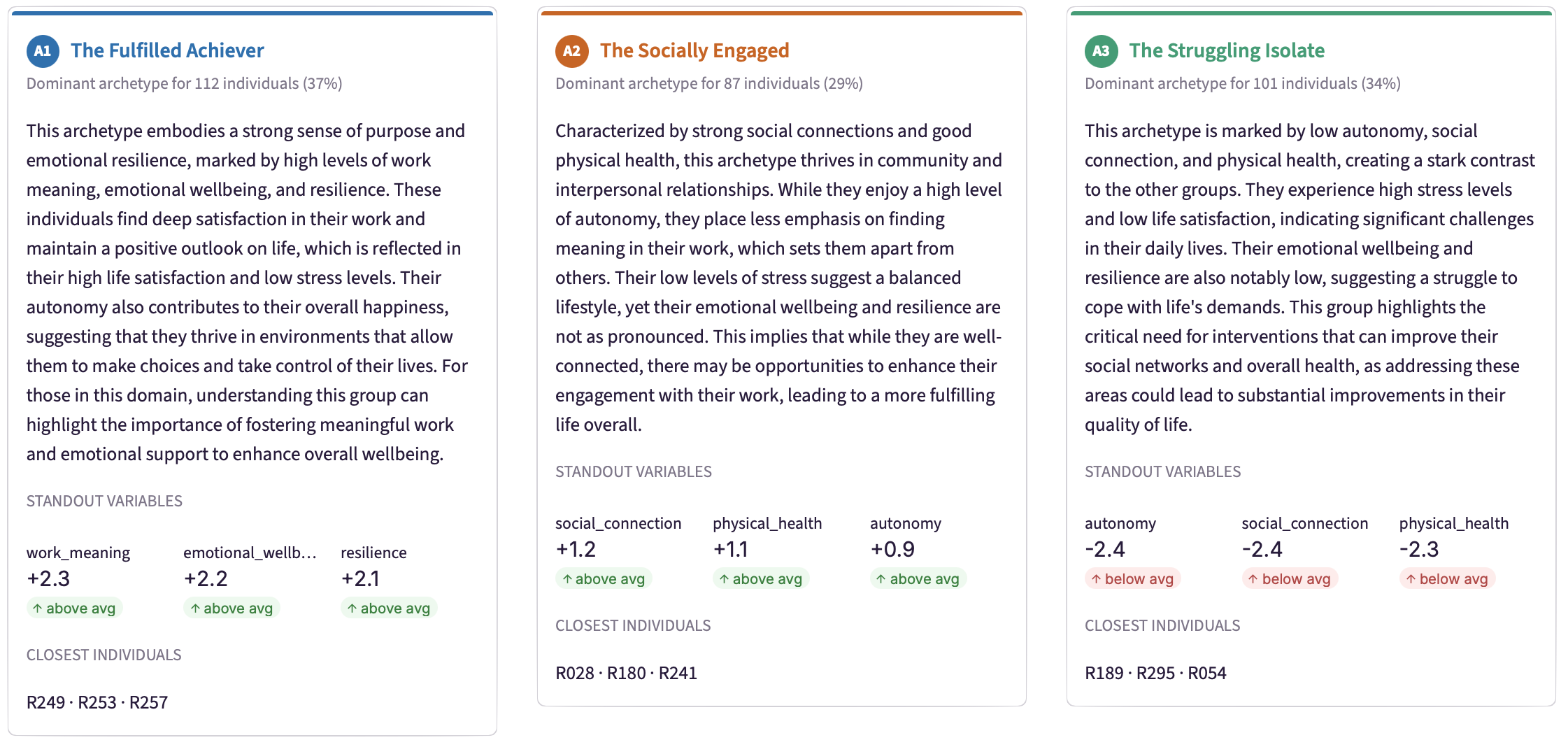
Lite (free) · Well-being dataset · 300 participants · 3 archetypes
Arkhety is built on Archetypal Analysis — a person-centered method that, for many respondent-by-variable datasets, captures structure better than alternatives like Clustering or Latent Profile Analysis (LPA). Where those methods rely on averages, Archetypal Analysis explains your data through its most extreme respondents.
| Clustering | LPA | Archetypal Analysis | |
|---|---|---|---|
| What it finds | Cluster centers (averages) | Latent classes (model-based averages) | Extreme reference profiles |
| Each respondent is… | Assigned to one cluster | Given a class probability | A mixture of a few profiles |
| Unusual cases | Pulled into the nearest cluster | Smoothed into a class | Become the reference points |
| How to read a profile | "Average of this group" | "Most likely response pattern" | "What an extreme respondent of this type looks like" |
Method introduced by Cutler & Breiman (1994). Arkhety brings it to your CSV — no R, no Python, no statistics expert required.
Pay per analysis, not per month. No subscription, no institutional contract. Designed for the way researchers actually work.
Free
€9 / analysis
Your raw data never leaves your browser. We don't store your CSV, we don't track you, and personal data is blocked at the door — designed to fit within institutional ethics and data protection requirements.
Your CSV stays in memory and is discarded when you close the tab. Only anonymous coordinates leave your browser, just to generate descriptions.
Files with names, emails, phone numbers or IDs are detected and blocked automatically. Compatible with GDPR and typical institutional ethics requirements.
No analytics, no ad pixels, no third-party cookies. Only the functional ones Streamlit needs to keep your session alive.
If Arkhety contributes to a publication, please cite it so others can reproduce your analysis.
@software{arkhety2026,
  author = {Alcacer, Aleix},
  title  = {Arkhety: Archetypal Analysis Without Code},
  year   = {2026},
  url    = {https://www.arkhety.com}
}Alcacer, A. (2026). Arkhety: Archetypal Analysis Without Code. https://www.arkhety.com